
Whether you are analyzing the market, gathering sources for an academic paper, or exploring competitive intelligence, managing information across many open browser tabs can be a major distraction. Standard AI chatbots often make this problem worse. They treat each conversation as a separate event, forcing you to re-enter your project details, personas, and formatting rules each time you start a new thread. Enter Perplexity AI Collections, also known as Spaces in the modern platform interface. Instead of treating AI searches as a series of disconnected text boxes, Collections let you create persistent research hubs specific to your project. By customizing these hubs with clear instructions, targeted source filters, and uploaded reference files, you can turn Perplexity into a tailored research assistant. This assistant remembers your project context, adheres to your output rules, and maintains a consistent analytical approach across various workflows.
This guide provides a detailed, step-by-step outline for building, configuring, and optimizing a Perplexity AI Collection for your professional or academic project research.
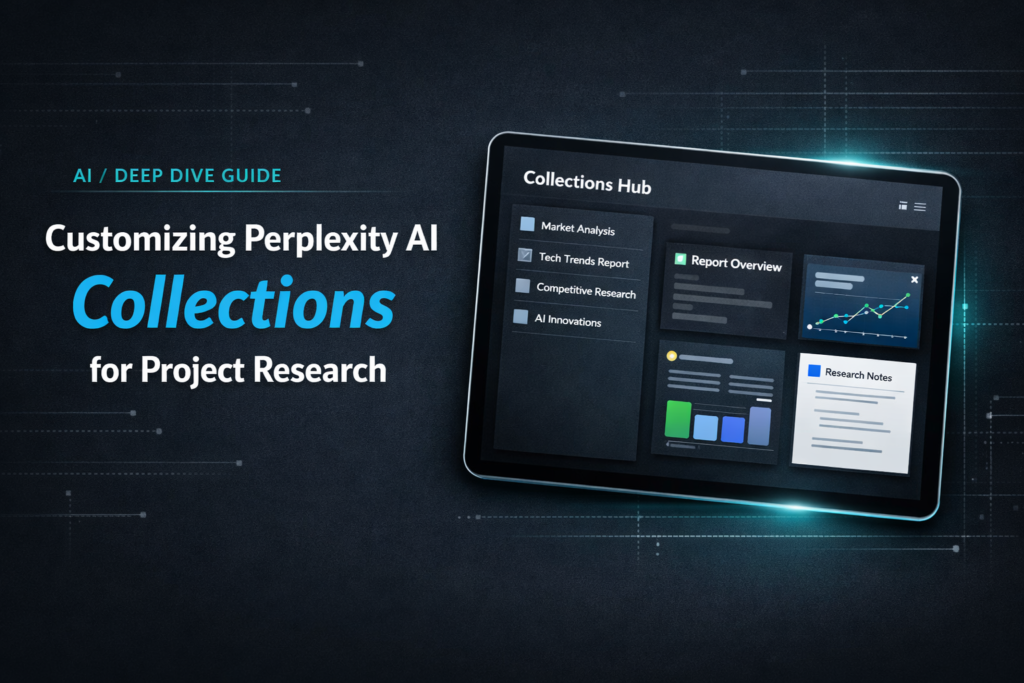
Understanding the Core Architecture of Perplexity Collections
- To make the most of a customized Collection, it’s helpful to understand how it changes the usual behavior of Perplexity’s underlying AI. In a regular, standalone Perplexity thread, the model starts fresh with each prompt. It relies on your global profile settings but lacks specific context about your current project goals. When you bundle threads within a Collection, you create a dedicated workspace. Every thread started within this workspace automatically inherits three key elements:
- Permanent Contextual Injection: The custom instructions created for the Collection are automatically added to every prompt you or your team members submit.
- Static Reference Anchors: Any files, PDFs, or data sheets uploaded to the Collection are accessible in every chat thread inside that workspace, so there’s no need to re-upload documents.
- Targeted Synthesis: The AI is encouraged to gather information across the specific web domains and filters you prioritize, reducing irrelevant search results.
By establishing this dedicated environment, you ensure that your research stays focused, well-contextualized, and free from the common formatting issues found in unconfigured AI models.
Setting Up Your Specialized Research Workspace
Setting up a new workspace takes less than a minute, but careful execution helps prevent future organizational clutter. Follow these steps to create your research hub:
- Access the Library Dashboard:
- Log into your Perplexity account and find the Library option in the left-side menu. This dashboard acts as the main directory for all your previous threads, discovered pages, and folder structures.
- Initialize a New Collection:
- Click the “+” icon next to the Collections or Spaces section header. This action opens a configuration setup overlay on your screen.
- Define Title, Description, and Scope:
- Give your workspace a specific name (e.g., Renewable Energy Market Analysis Q3 2026 or Micro-Plastic Environmental Impact Study). Include a brief description of the project’s main objectives to keep everyone on the same page. Avoid vague titles like “Research” or “Project 1.”
- Configure Custom AI Settings:
- Open the advanced settings to reveal the Custom AI Instructions prompt field. This is where you set the permanent rules that govern the AI’s behavior.
Prompt Engineering for Collection Instructions
The real strength of a customized Collection lies in its system instructions. This text field requires the AI model, whether it’s Claude, GPT, or another reasoning engine, to consistently take on a specific role and output format. When writing your instructions, avoid vague phrases like “Be helpful, thorough, and precise.” Instead, provide clear directions, specific sourcing rules, and structural formatting guidelines.
Key Elements of an Effective Instruction Framework
To create a reliable set of instructions, ensure your prompt covers these four areas:
- The Professional Persona: Define the exact skills, tone, and mindset the AI should adopt (e.g., “Act as a clinical trial auditor”).
- Sourcing Hierarchies: Guide the model on which types of data to prioritize and what to ignore (e.g., “Prioritize raw SEC filings; ignore speculative secondary news blogs”).
- Analytical Constraints: Specify how the data should be validated (e.g., “Always search for conflicting metrics across sources and point out discrepancies”).
- Structural Layout Rules: Set the default format for presenting information (e.g., “Use Markdown tables for comparative data and limit introductory text”).
Production-Ready Instruction Templates
You can copy, paste, and adjust these templates for your Collection based on the project type:
Template A: Academic & Technical Literature Synthesis
“Act as a Senior Academic Researcher and Literature Review Specialist. For every search query within this Space, prioritize peer-reviewed literature, institutional whitepapers, and official regulatory documents.
Operational Constraints:
- For each statistical claim or data point referenced, append an inline citation linked to the primary source.
- If a query reveals conflicting scientific data or differing conclusions, create a section called ‘Divergent Perspectives in Literature’ to highlight the differences.
- Skip filler phrases, introductions, and conclusions. Start every response with the data synthesis requested. Use neat Markdown lists and tables for complex historical timelines or technical processes.”
Template B: Market Intelligence & Business Strategy
“Act as a Principal Market Intelligence Analyst specializing in corporate strategy. Your aim is to extract actionable commercial data, financial filings, market share information, and industry reports.
Operational Constraints:
- Maintain a concise, objective tone.
- For each competitive insight or market change, organize the output into three strict sections:
- Core Discovery: A single-sentence summary of the finding.
- Supporting Verified Data Points: A bulleted list of facts, revenue numbers, or dates, with sources.
- Strategic Implication: An analysis of how this affects market competitors.
- Use a detailed Markdown matrix for comparing product features or pricing tiers.”
Maximizing Efficiency with Focus Filters
Perplexity provides built-in Focus Filters at the initialization of individual threads within your Collection. Restricting the AI’s search perimeter from the outset prevents your project from being cluttered with low-value, SEO-optimized web spam, commercial listicles, or shallow blog articles.
| Focus Filter | Primary Source Materials Checked | Best Project Research Use Case |
| Academic | Semantic Scholar, arXiv, PubMed, and leading global scientific journals. | Deep theoretical research, historical validation, and auditing peer-reviewed proofing. |
| Writing | None (Executes purely localized generation using the underlying LLM’s static weights). | Drafting structural project outlines, rewriting rough notes, or formatting raw data into formal reports. |
| All (Default) | The entire indexed public web canvas, news sites, and company homepages. | Real-time market positioning, tracking breaking industry news, or identifying regulatory policy shifts. |
| YouTube / Reddit | Public video transcripts, developer subreddits, and open community forums. | Qualitative sentiment mining, mapping real-world user pain points, and product UX case studies. |
File Upload Anchors and the Long-Term Memory Protocol
A common point of confusion among research teams is understanding how memory works across different threads within a single Collection.
Threads inside a Collection act as organized, searchable storage compartments. However, each new chat thread in that Collection starts a new contextual memory loop. A new thread does not read or scan the text transcripts of other threads in the same folder. Instead, continuity between parallel threads relies on two main elements: your global Custom AI Instructions and your Uploaded Reference Files.
The File Upload Strategy
To turn your Collection into a cohesive knowledge engine, use the file upload feature as a permanent anchoring tool. You can upload files up to 25MB directly to the main workspace settings page of the Collection.
What to Upload: Upload foundational project briefs, internal product documentation, key CSV data spreadsheets, target audience profiles, or detailed industry glossaries.
How the AI Uses Them: When you start a new thread to research an external market trend, the AI automatically checks your web search results against those permanently uploaded internal files. This ensures that its analysis matches your internal business needs.
Preserving Breakthroughs via “Convert to Page”
When a specific, in-depth conversation inside your Collection leads to a major research breakthrough, a large data compilation, or a well-structured report, do not let it get lost in a long chat transcript.
Use Perplexity’s Convert to Page feature. This tool turns the raw conversation history into a clean, standalone document. You can refine this document, add subheadings, include additional notes, and pin it to the top of your Collection workspace. It becomes an easily accessible, polished reference for team members and stakeholders.
Deep Research Mode (Autonomous, Multi-Step Investigation)
For the foundational discovery phase of your project, activate Deep Research mode. Instead of executing a superficial search and summarizing the first three links it finds, Deep Research allows Perplexity to act as an autonomous agent. It will systematically execute dozens of sequential, parallel queries over several minutes, follow citation trails down deep digital rabbit holes, cross-verify conflicting metrics, and compile a massive, thoroughly comprehensive research report that can save you days of manual digging.
Summary Checklist for a High-Performance Collection
To ensure your workspace is fully optimized before diving into your next research sprint, verify that you have checked off the following four operational steps:
- Specific Domain Naming: The Collection is named after a distinct project or client rather than a generic task.
- Four-Part Custom Prompt: The custom instructions outline a specific professional persona, source preferences, analytical guardrails, and structural formatting layouts.
- Foundational File Anchors: Core reference documentation, guidelines, or baseline datasets are uploaded directly to the Collection settings.
- Strategic Model Alignment: The active AI engine is deliberately selected based on whether your current workflow phase demands rapid synthesis, deep reasoning, or autonomous deep investigation.
By taking ten minutes to map out your custom parameters and anchor your core documents within a dedicated Collection workspace, you eliminate repetitive prompt engineering and transform your research workflow from an endless sea of scattered browser tabs into a precise, automated knowledge engine.